
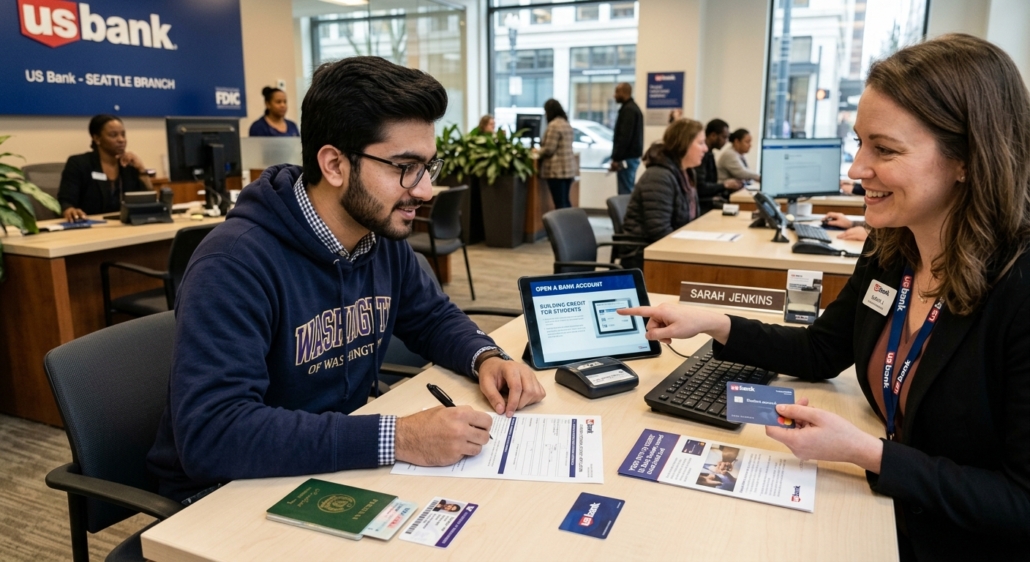
Opening a US bank account for students is not the hard part
Most guides make this sound like the whole problem. It isn’t. Walking into a branch with a passport and an I-20 and walking out with a debit card takes maybe forty minutes. The part that actually trips up Pakistani students is what happens in the six months after that: no SSN, no credit file, and a landlord or phone company that wants both.
A US bank account for students is the easy half of this. The other half, building something a lender will trust, takes longer and gets skipped over in almost every article on this topic. That’s the gap this post is trying to close.
SSN or ITIN: the question that stalls everyone
Here’s the thing nobody tells you upfront: you do not need a Social Security Number to open a checking account. You need one to work legally, to file taxes, and eventually to build a full credit profile. Those are three separate things, and conflating them is why students delay opening an account for weeks waiting on paperwork they don’t actually need yet.
If you haven’t secured on-campus employment yet, you still qualify for a checking account. Banks route non-residents through their standard account-opening process using passport and visa documents instead. An ITIN (Individual Taxpayer Identification Number) matters more for tax filing than for banking, and most students never need one until their first US tax season.
Do not wait for an SSN before opening a US bank account for students — open the account first, add the SSN once you have a campus job.
What you actually need to bring
Documents needed for Pakistani students to open a US bank account are more predictable than the SSN confusion suggests. Bring these to the branch, not scanned copies on your phone:
-
Your Pakistani passport, valid and not expiring within the semester.
-
Your I-20 (or DS-2019 if you’re on exchange), issued by your university.
-
Proof of a US address — a signed housing contract, dorm assignment letter, or utility bill works.
-
A secondary form of ID. Chase, for instance, accepts an Employment Authorization Card or a Matrícula Consular Card as secondary identification for international students, according to Chase.
Which bank should you actually pick?
National chains and regional banks solve different problems. A national bank gets you fee-free ATM access if you travel between cities or go home for summer break. A regional or credit union sometimes waives more fees outright, but its ATM network stops at the state line.
|
Bank |
Fee waiver |
Notable feature |
|---|---|---|
|
U.S. Bank |
Waived for account holders 24 and under |
Youth and student checking, per U.S. Bank |
|
Chase |
Waivable with balance or direct deposit |
Accepts EAD or Matrícula Consular as secondary ID |
|
Bank of America |
No fee under SafeBalance for teens |
Teens 16+ can be sole account owner, per Bank of America |
For most Pakistani students starting a degree, Chase or U.S. Bank cover the basics: campus branches, mobile check deposit, and a debit card you can use the day you land. If your university town has a strong local credit union, it’s worth a look too, but don’t assume smaller always means cheaper.
Joint account or independent account — does it matter?
If you’re 16 or older and a parent is willing to co-sign, some banks let you skip straight to a joint teen account. U.S. Bank allows teens aged 13 to 17 to open jointly with a parent or guardian, either online or in a branch, according to U.S. Bank. Most graduate and undergraduate students arriving on an F-1 visa, though, are past that age and open independently — which is the more common path and the one this post assumes.
Sending money from Pakistan without losing a chunk of it
This is where most banking guides go quiet, and it’s genuinely the part that costs Pakistani families real money. Wiring tuition and living expenses directly from a Pakistani bank through the State Bank of Pakistan’s remittance channels usually comes with a fixed wire fee plus an exchange rate spread, often 2 to 4% worse than the mid-market rate. Compare that against services like Wise or a bank-to-bank SWIFT transfer before your first tuition payment lands, because the difference on a $15,000 transfer is not small.
Once your US bank account for students is open, ask the bank directly what its incoming international wire fee is. Some waive it for the first deposit; most don’t. Budget for a $15 to $45 receiving fee on top of whatever your Pakistani bank charges to send it.
Building credit history in the US when you have none
This is the part every other article treats as a footnote, and it’s the one that actually shapes your financial life for the next four years. No SSN-linked history means no FICO score, which means no unsecured credit card, which means no way to build a score. It’s circular by design, and there’s exactly one way through it.
Open a secured credit card. You put down a deposit, usually $200 to $500, and that becomes your credit limit. Discover, Capital One, and several credit unions offer secured credit cards for international students specifically, with no SSN required if you have an ITIN or in some cases just a passport and proof of enrollment.
Use the card for something small and recurring — a Spotify subscription, a coffee habit — and pay the full balance every single month. Do this for six to twelve months and your file starts showing payment history, which is the single heaviest factor in a US credit score.
After that window, most students can move to a student credit card option built for no credit history, things like the Discover it Student or Bank of America’s Travel Rewards for Students. These report to all three bureaus and slowly widen what you can qualify for: a car loan, an apartment lease without a hefty deposit, eventually a mortgage if you stay.
One thing worth saying plainly: closing your secured card the moment you get approved for an unsecured one is a mistake almost everyone makes. Keep the old account open. Length of credit history matters almost as much as payment history, and a two-year-old account beats a two-month-old one every time.
The one thing to decide before you land
Pick your bank before you arrive, not after. Whether you settle on Chase, U.S. Bank, or a local credit union near campus matters less than doing it in week one, not week six. The account is fast to open. The credit file behind it is what takes the actual time, and that clock only starts once you do.
Frequently asked questions
Can international students open a US bank account without an SSN?
Yes. Most major banks will open an account using your passport and I-20, and some accept a Matrícula Consular Card or Employment Authorization Card as secondary ID. You do not need a Social Security Number to open the account itself, only for certain features like a linked credit product later on.
What documents are required to open a student checking account in the US?
You typically need your passport, your I-20 or DS-2019, proof of your US address, and your visa. Chase accepts an Employment Authorization Card as secondary identification for international students, according to Chase.
How can an international student build credit in the US?
Start with a secured credit card, since you have no SSN-linked credit file to draw on. Pay the full statement balance every month for six to twelve months, then apply for an unsecured student card and keep the secured card open.
Which US bank is best for international students?
It depends on what you’re optimizing for. U.S. Bank waives monthly fees for account holders 24 and under, Chase has broader branch coverage, and Bank of America lets teens 16 and older open a SafeBalance account as sole owner.
{“@context”:”https://schema.org”,”@type”:”FAQPage”,”mainEntity”:[{“@type”:”Question”,”name”:”Can international students open a US bank account without an SSN?”,”acceptedAnswer”:{“@type”:”Answer”,”text”:”Yes. Most major banks will open an account using your passport and I-20, and some accept a Matrícula Consular Card or Employment Authorization Card as secondary ID. You do not need a Social Security Number to open the account itself, only for certain features like a linked credit product later on.”}},{“@type”:”Question”,”name”:”What documents are required to open a student checking account in the US?”,”acceptedAnswer”:{“@type”:”Answer”,”text”:”You typically need your passport, your I-20 or DS-2019, proof of your US address, and your visa. Chase accepts an Employment Authorization Card as secondary identification for international students, according to Chase .”}},{“@type”:”Question”,”name”:”How can an international student build credit in the US?”,”acceptedAnswer”:{“@type”:”Answer”,”text”:”Start with a secured credit card, since you have no SSN-linked credit file to draw on. Pay the full statement balance every month for six to twelve months, then apply for an unsecured student card and keep the secured card open.”}},{“@type”:”Question”,”name”:”Which US bank is best for international students?”,”acceptedAnswer”:{“@type”:”Answer”,”text”:”It depends on what you’re optimizing for. U.S. Bank waives monthly fees for account holders 24 and under, Chase has broader branch coverage, and Bank of America lets teens 16 and older open a SafeBalance account as sole owner.”}}]}


Leave a Reply
Want to join the discussion?Feel free to contribute!