
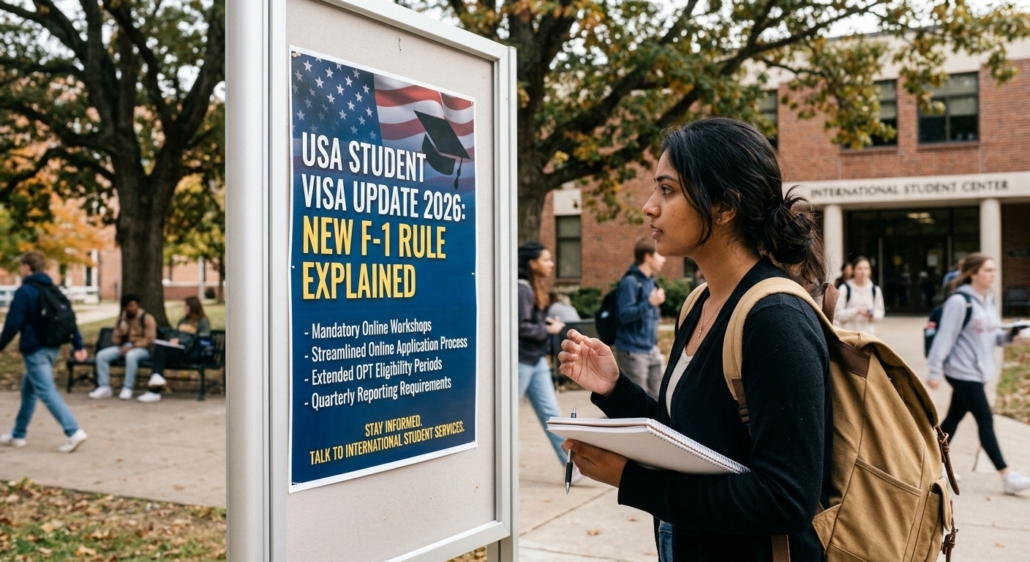
USA Student Visa Update 2026: What International Students Need to Know
If you are planning to study in the United States, or you are already there on an F-1 visa, this USA student visa update matters more than most. On July 17, 2026, the Department of Homeland Security (DHS) published a final rule that ends the decades-old “Duration of Status” system for F-1 and J-1 visa holders. This is being called one of the most significant shifts to US student visa policy in a generation, and it takes effect on September 15, 2026.
Below, we break down exactly what this policy shift means, who it affects, and the practical steps every international student should take before the new rule kicks in.
What Is Changing
For decades, an F-1 student visa allowed a person to remain in the United States for as long as they were enrolled full-time and making normal progress toward their degree. There was no fixed expiration date printed on the paperwork itself. This model was known as “Duration of Status,” or D/S.
That system is now being replaced. Under the new DHS rule, F-1 and J-1 students will be admitted for a fixed period tied to their program length, capped at a maximum of four years, whichever is shorter. This end date will appear directly on the student’s Form I-94, the official US arrival and departure record.
This change removes the open-ended flexibility that international students have relied on for generations. A visa is no longer just a gateway with indefinite stay potential; it now comes with a hard, visible deadline.
Reduced Grace Period: A Key Detail in the New Rule
Another important part of this policy change is the shortened departure grace period. Previously, F-1 students had 60 days after completing their program to prepare to leave the country, transfer schools, or change their immigration status. Under the new rule, that window shrinks to just 30 days.
This matters for anyone finishing a degree, applying for Optional Practical Training (OPT), or planning to transfer institutions. With half the buffer time, students will need to plan their post-graduation steps far earlier than before.
For J-1 exchange visitors, the grace period remains at 30 days, unchanged from current practice. However, students and dependents who leave the US and re-enter on or after September 15, 2026, will also see their F-1 grace period drop to 30 days, even if they were previously operating under different terms.
Who the New F-1 Rule Affects
One detail that surprises many people is that this rule does not apply only to new arrivals. Students currently in the United States under the old Duration of Status framework will also transition into the new fixed-period system automatically. Their authorized stay will be capped at four years from the rule’s effective date, regardless of when their program was originally expected to end.
In practical terms, this means:
-
Students entering the US on or after September 15, 2026, are admitted under the new fixed-period system from day one.
-
Students already in the US on that date do not need to take immediate action, but they become subject to the new deadlines going forward.
-
Anyone needing more time beyond their fixed admission period, such as students in longer PhD programs, must apply for an Extension of Stay (EOS) through US Citizenship and Immigration Services (USCIS) before their authorized period expires.
International journalists on media visas face an even tighter window under this same rule, limited to 240 days per entry, or 90 days for journalists from China, though this affects a much smaller population than the core student visa changes.
Why This Change Is Happening Now
According to DHS, the goal of this rule is to close what officials describe as loopholes in the previous open-ended system, which allowed some visa holders to remain in the country far longer than their academic programs justified. A nearly identical rule was first proposed in 2020 during the previous Trump administration but was withdrawn in 2021. The proposal was revived in August 2025 and, after drawing criticism from universities and medical education groups over concerns about research continuity and residency training, was finalized in July 2026.
This update also arrives alongside other recent shifts affecting international students, including changes to the H-1B work visa selection process and increased enforcement scrutiny across F-1 programs generally. Together, these changes signal a broader tightening of the US immigration landscape for students and early-career professionals.
What Students Should Do Right Now
Given the scope of these changes, designated school officials (DSOs) are expected to play a bigger advising role going forward. In the meantime, students already in the US or planning to arrive should:
-
Confirm your official program end date with your school’s international student office, since this now directly determines your legal stay.
-
Check your I-94 record on the US Customs and Border Protection website once the rule takes effect, and keep a personal copy.
-
Calendar the four-year clock from September 15, 2026, and compare it against your expected graduation date.
-
Avoid last-minute program or school changes, as the new rule introduces stricter limitations on academic changes, particularly early in a program.
-
Talk to your DSO early about whether you will need to file an Extension of Stay, especially if you are in a longer degree program such as a PhD.
Final Thoughts
This USA student visa update represents a genuine structural change, not a minor policy tweak. The shift from Duration of Status to a fixed admission period, combined with a shorter grace period, means international students can no longer treat their visa as an indefinite arrangement tied loosely to enrollment. It is worth noting that DHS itself has acknowledged the September 15, 2026 effective date could still shift, since the rule remains subject to congressional review and possible legal challenges.
Students, universities, and advisors should treat this as evolving guidance rather than a fixed and final picture. Staying in close contact with your school’s international student office, and checking official USCIS and DHS sources directly, remains the most reliable way to stay ahead of this fast-moving policy shift.


Leave a Reply
Want to join the discussion?Feel free to contribute!