
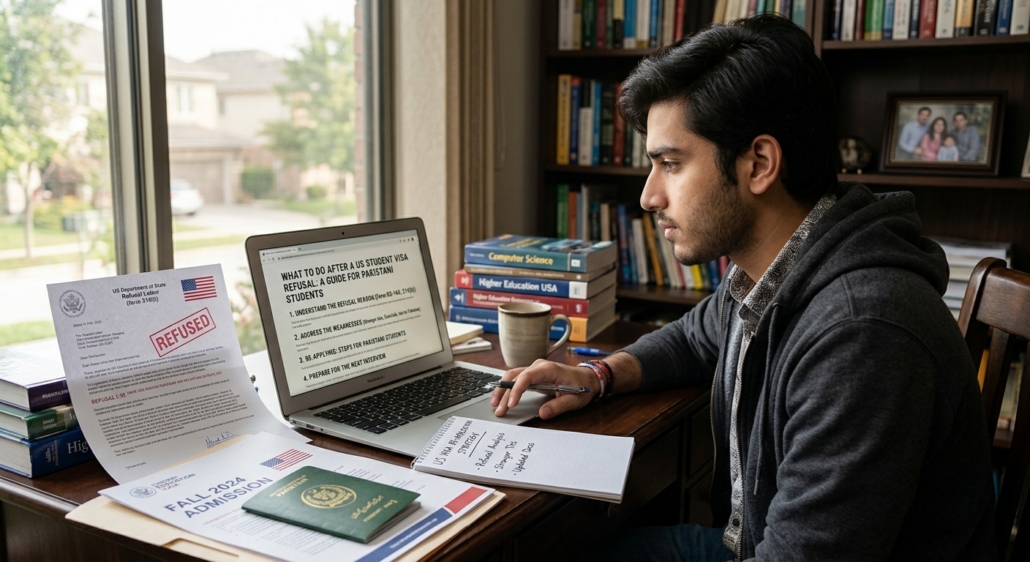
A US visa refusal from Pakistan requires an immediate audit of your DS-160 form and a formal request for a university deferral if your program start date is within 30 days. You must identify the specific reason for the rejection—typically documented as Section 214(b)—before paying a new $185 MRV fee and scheduling a second interview.
Receiving a yellow or white slip at the end of an interview in Islamabad or Karachi is frustrating, but it is not a permanent ban. Most Pakistani students fail not because they are unqualified, but because they did not successfully rebut the legal presumption that they intend to immigrate to the United States. To win on your second attempt, you have to treat the process like a data correction exercise rather than an emotional appeal.
What to do after a US visa refusal from Pakistan
The first step is to read the refusal letter carefully. In almost every case for Pakistani students, the rejection falls under Section 214(b) of the Immigration and Nationality Act. This means the consular officer was not convinced you have a residence in Pakistan that you have no intention of abandoning. It is a broad catch-all that covers everything from weak financial evidence to a lack of clarity about your future career in Lahore, Karachi, or Islamabad.
You cannot appeal this decision. There is no manager to speak with and no letter you can write to the embassy to overturn it. The only way forward is reapplying for US student visa after refusal by submitting a new application and paying the fees again. Before you do that, you must address the gaps in your original case. If you present the exact same profile a second time, the result will be the same.
In fiscal year 2025, the US State Department reported an adjusted B-visa refusal rate for Pakistani applicants of 52.32%, according to opaige.com. While F-1 student visas have different criteria, this high baseline reflects the intense scrutiny placed on all nonimmigrant applications coming from the region. You are fighting against a statistical trend, so your evidence must be airtight.
Decoding the reasons for US F1 visa rejection in Pakistan
Officers rarely give a detailed verbal explanation during the interview. They might say, “Your ties are not strong enough,” or “You don’t qualify at this time.” However, the actual reasons for US F1 visa rejection in Pakistan often hide in the logistics of your application. Common triggers include:
-
Sudden “bulk” deposits in your bank account that do not match your family’s documented income history.
-
Choosing a university or program that is a lateral move rather than an advancement (e.g., applying for a second Master’s in the same field).
-
Vague answers about what you will do in Pakistan after graduation.
-
Discrepancies between your DS-160 and your verbal answers.
If you were rejected, look at your financial documents. A common mistake is showing a bank statement with 10 million PKR deposited just three days before the interview. To a consular officer, this looks like “parked” money—funds borrowed from a relative just to show a balance. They want to see a history of transactions that proves the sponsor has sustained financial capacity. Review the US Student Visa Requirements for Pakistan to ensure your funding sources meet the embassy’s expectations.
How to handle your I-20 and university deferrals
If your semester starts in two weeks and you just got a US visa refusal from Pakistan, you likely cannot get a new appointment in time. Do not try to rush a “walk-in” or send desperate emails to the embassy. Instead, contact your university’s International Student Services (ISS) office. Tell them you were refused under 214(b) and need to defer your admission to the next intake.
The university will issue a new I-20. Most of the time, your SEVIS ID (the N00 number at the top) will stay the same. This is crucial because it means you do not have to pay the $350 SEVIS I-901 fee again. You just need the updated document with the new start date. If the university issues a completely new SEVIS ID, you will have to transfer your old payment to the new record via the SEVIS website. Never go to a second interview with an expired start date on your I-20.
|
Scenario |
Required Action |
Cost Involved |
|---|---|---|
|
Semester starts in > 30 days |
Keep current I-20; seek earlier appointment. |
$185 MRV Fee |
|
Semester starts in < 15 days |
Request university deferral and new I-20. |
$185 MRV Fee |
|
SEVIS ID remains the same |
Update DS-160 with new dates. |
None for SEVIS |
|
New SEVIS ID issued |
Transfer SEVIS fee online before interview. |
None (if transferred) |
The logistics of reapplying for US student visa after refusal
When you are ready to try again, you must start a new DS-160. Do not simply copy-paste everything from the old one. There is a specific question that asks: “Have you ever been refused a U.S. Visa?” You must answer “Yes.”
This is where many students fail. In the text box provided for how to explain visa refusal in DS-160, do not write a paragraph complaining about the previous officer. Also, do not just write “I don’t know.” A strong explanation acknowledges the previous concern and states what has changed. For example: “I was previously refused under 214(b). I have now provided additional property valuation and a job offer letter from a Pakistani firm contingent on my return with this degree.”
The machine-readable visa (MRV) fee of $185 is non-refundable. According to mytravelready.ai, this fee must be paid for every new application attempt. Given the 4.1 million B1/B2 applications filed globally in 2024 as noted by atlys.com, the system is backed up. You should pay the fee at Allied Bank as soon as possible to see the available calendar slots at the US embassy Islamabad student visa reapplication portal.
Mastering the section 214b visa refusal Pakistan context
The section 214b visa refusal Pakistan issues are almost always about “intent.” As a student, you are not expected to own a house or have a 20-year career. So, how do you prove ties? You prove them through your “future” in Pakistan. This is an area where you can actually disagree with common “consultant” advice in Pakistan. Many consultants tell you to show land papers. Land papers are fine, but a detailed career map is better.
If you are studying Data Science, do not just say you want to work for a “big company.” Mention specific Pakistani sectors like the growing FinTech landscape in Karachi or the agricultural tech initiatives in Punjab. Showing that you have researched the local job market proves that you have a reason to come back. You are not just going to the US to escape; you are going there to specialize and return to a high-paying niche that only exists for those with foreign qualifications.
For more specific guidance on the conversation itself, check out these F1 visa interview tips and questions for Pakistani students 2026. The rhythm of the interview is fast. You often have less than 120 seconds to make your case. If you spend 30 seconds of that time fumbling for a bank statement, you have already lost the officer’s attention.
Effective US visa interview tips for Pakistani students
The second interview is usually harder than the first. The officer will see the previous refusal on their screen immediately. Their first question will likely be: “What has changed since your last application?” If your answer is “Nothing,” your interview might end right there.
Your goal is to provide a “material change” in your application. This could be a new scholarship, a more detailed sponsorship letter, or a clearer explanation of your study plan. If you were originally going for a generic MBA at a low-ranked school, perhaps you have now been accepted into a more specialized program that aligns better with your previous work experience in Lahore. That is a material change.
The USA Student Visa Update 2026: New F-1 Rule Explained guide highlights how the US is shifting focus toward STEM and high-value research. If your program falls into these categories, emphasize it. Don’t just say “I am studying Engineering.” Say “I am specializing in power grid resilience, which is a critical need for Pakistan’s energy sector.” This shifts the conversation from your “intent to stay” to your “value upon return.”
Addressing the financial “Deep Dive”
For a US visa refusal from Pakistan, the financial sponsor is often the weak link. If your father is your sponsor, his tax returns (FBR filings) should ideally match the wealth shown in the bank statement. If there is a massive gap, the officer will assume the money is not truly available for your education.
If you are using a third-party sponsor (an uncle or a distant relative), your chances are lower. The US embassy in Pakistan prefers immediate family or self-funding. If you must use a relative, they need to provide an affidavit of support that explains why they are spending 15 million PKR on your education instead of their own children’s. Without that logic, the officer will likely trigger a 214(b) rejection again.
Worth saying: do not bring “Property Valuations” that look like they were printed yesterday by a local agent. They see thousands of these. Instead, focus on liquid assets and the steady income of the sponsor. If the sponsor owns a business, bring the business registration and bank statements of the business itself to show the source of the personal wealth. Transparency is the only way to beat a US visa refusal from Pakistan based on financial doubt.
The “First Attempt” mentality for the second try
You need to approach the reapplication with the same freshness as a first-timer but with more precision. Use the Tips to get USA visa in first attempt as a checklist to see what you missed. Did you dress too formally? Were you too rehearsed? Did you look the officer in the eye?
In Pakistan, there is a cultural tendency to be overly deferential to authority, which can come across as lack of confidence or even appearing “shady” to an American officer. Speak clearly. If they ask a question you don’t understand, ask them to repeat it. Do not guess. A wrong answer is viewed as a lie, and a lie is a permanent 6C1 fraud charge, which is much worse than a 214(b) refusal.
Common FAQ for Pakistani Students
Can I reapply immediately after receiving a 214(b) US visa refusal from Pakistan?
Yes, there is no legal waiting period. You can technically book a new appointment as soon as one is available. However, reapplying the following week without changing your application or gathering new evidence almost always leads to a second rejection. It is better to wait until you have a new I-20 or better financial documentation.
How do I prove strong ties to Pakistan if I am a student with no property or job?
You must demonstrate “social and economic ties.” Social ties include your family staying in Pakistan. Economic ties for a student are “prospective.” Show a clear understanding of the Pakistani job market and how your specific degree from a specific US university makes you a top-tier candidate for local firms. Mentioning a family business you intend to modernize is also a strong tie.
Do I need a new DS-160 and SEVIS fee payment to reapply for an F-1 visa after rejection?
You need a new DS-160 and you must pay the $185 MRV fee again. You do not need to pay the SEVIS fee again if you are returning with the same SEVIS ID. If you have been out of the country or your SEVIS record was terminated, you might need a new payment, but for a standard reapplication, the original payment remains valid for 12 months.
What should I do if my US visa is refused and my university semester has already started?
You cannot travel after the “Start Date” listed on your I-20. If you are refused near that date, you must ask your university to defer your admission to the next semester. They will update your record in the SEVIS system and send you a new I-20. You will then use this new I-20 for your next visa interview attempt.
{“@context”:”https://schema.org”,”@type”:”FAQPage”,”mainEntity”:[{“@type”:”Question”,”name”:”Can I reapply immediately after receiving a 214(b) US visa refusal from Pakistan?”,”acceptedAnswer”:{“@type”:”Answer”,”text”:”Yes, there is no legal waiting period. You can technically book a new appointment as soon as one is available. However, reapplying the following week without changing your application or gathering new evidence almost always leads to a second rejection. It is better to wait until you have a new I-20 or better financial documentation.”}},{“@type”:”Question”,”name”:”How do I prove strong ties to Pakistan if I am a student with no property or job?”,”acceptedAnswer”:{“@type”:”Answer”,”text”:”You must demonstrate “social and economic ties.” Social ties include your family staying in Pakistan. Economic ties for a student are “prospective.” Show a clear understanding of the Pakistani job market and how your specific degree from a specific US university makes you a top-tier candidate for local firms. Mentioning a family business you intend to modernize is also a strong tie.”}},{“@type”:”Question”,”name”:”Do I need a new DS-160 and SEVIS fee payment to reapply for an F-1 visa after rejection?”,”acceptedAnswer”:{“@type”:”Answer”,”text”:”You need a new DS-160 and you must pay the $185 MRV fee again. You do not need to pay the SEVIS fee again if you are returning with the same SEVIS ID. If you have been out of the country or your SEVIS record was terminated, you might need a new payment, but for a standard reapplication, the original payment remains valid for 12 months.”}},{“@type”:”Question”,”name”:”What should I do if my US visa is refused and my university semester has already started?”,”acceptedAnswer”:{“@type”:”Answer”,”text”:”You cannot travel after the “Start Date” listed on your I-20. If you are refused near that date, you must ask your university to defer your admission to the next semester. They will update your record in the SEVIS system and send you a new I-20. You will then use this new I-20 for your next visa interview attempt.”}}]}


Leave a Reply
Want to join the discussion?Feel free to contribute!