
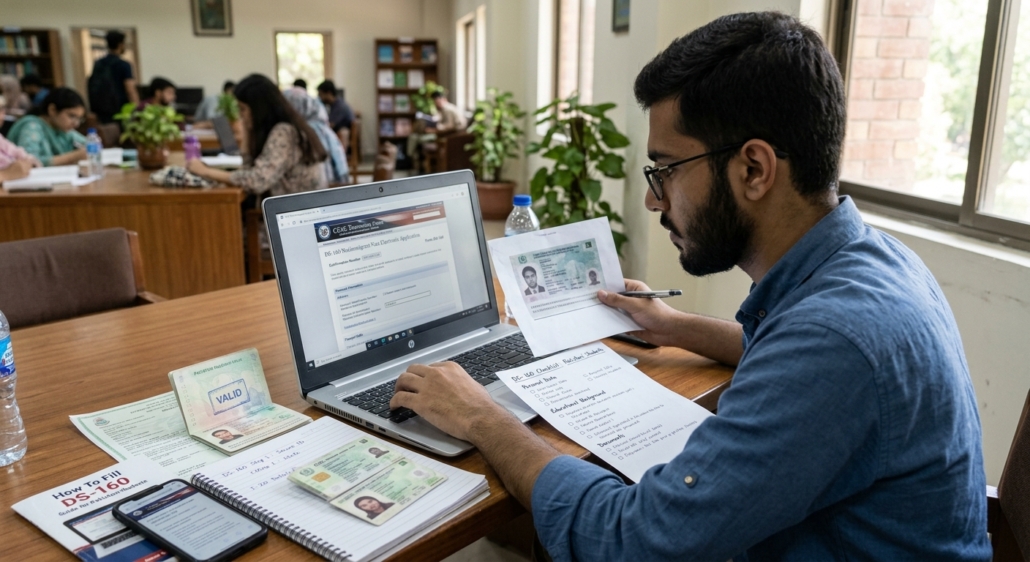
The DS-160 is not hard. It is long, repetitive, and unforgiving of small mistakes, but it is not hard. Most Pakistani students who get stuck on it aren’t confused by the questions themselves — they get stuck on the SEVIS number, the photo upload, or the fact that one wrong click resets a whole page. This DS-160 form guide is built around those actual sticking points, not the generic instructions on the State Department’s own site.
Why the DS-160 form guide starts before you open the form
Open the form cold and you will lose an hour just hunting for your own information. Your I-20 program start date, your SEVIS ID, your father’s date of birth, the exact spelling of your address as it appears on your CNIC. None of this is hard to find. All of it needs to be in front of you before the session timer starts, because the DS-160 logs you out after 20 minutes of inactivity and does not always save your last unsaved page.
This is also where the paperwork side matters more than people expect. If your I-20, your financial documents, and your DS-160 answers don’t line up, an officer notices before you say a single word in the interview. It’s worth going through the full US Student Visa Requirements for Pakistan checklist first, so the DS-160 form guide you follow after that is filling in facts you’ve already confirmed, not guessing at them.
The nine sections, and where people actually trip
The form runs through personal information, travel plans, travel companions, previous US travel history, your address and phone number, passport details, US contact information, family information, and then work, education, and training history, before ending on security and background questions. Most of these are copy-paste from your passport and I-20. Three of them are not.
-
Travel information: your intended date of arrival should match your I-20 start date minus a small buffer, not the date your semester actually begins.
-
Previous US travel: even a childhood visit on a parent’s visa counts and needs to be listed, with approximate dates if you don’t remember exact ones.
-
Work and education history: every school since secondary school needs an address, not just a name, which trips up applicants who attended smaller colleges with no formal registered address online.
The photo and the SEVIS number: two ways to fail for dumb reasons
Your photo has to be 600 by 600 pixels, taken in the last six months, against a plain white or off-white background. No glasses. No shadow on the wall behind you. The upload tool will reject anything outside spec before you even get to submit, which sounds like a safeguard until you realize it doesn’t tell you *why* it failed half the time. Take the photo at a proper studio, not on a phone against a bedsheet.
Your SEVIS number starts with an N and sits at the top right corner of your I-20. It has to match your school’s SEVIS code exactly, and your program start date on the DS-160 has to match the I-20 to the day. A one-day mismatch here is the single most common reason applications get flagged for review before the interview is even scheduled.
The honesty section nobody enjoys filling out
Security and background questions ask about health, criminal history, and — since 2019 — social media usernames across a specific list of named platforms, going back five years. Not passwords, just handles. Skipping a platform you clearly use, one that shows up in a basic search, reads as an inconsistency, and inconsistencies are what get files pulled for closer review.
None of this is about being interesting or clean online. It’s about the answers matching what’s checkable. A student with a public, ordinary Instagram account and an honest DS-160 has nothing to worry about here. A student who leaves the field blank because it feels invasive has created a small problem out of nothing.
|
Mistake |
What it causes |
The fix |
|---|---|---|
|
SEVIS number typo |
Flagged for manual review, delayed appointment |
Copy directly from the I-20, don’t retype from memory |
|
Program start date mismatch |
Officer questions your paperwork’s consistency |
Match the I-20 date exactly, to the day |
|
Photo rejected by upload tool |
Can’t submit until it’s replaced |
Use a studio photo, 600x600px, plain background |
|
Blank social media field |
Reads as omission rather than honesty |
List every platform used in the last five years |
The confirmation page is not just paperwork
Once you submit, you get a confirmation page with a barcode and a ten-digit number. Print it. Save it as a PDF too. You need that number to pay your visa fee and to schedule your appointment at the US Embassy in Islamabad or a consulate in Karachi, Lahore, or Peshawar, and losing it means digging through your Application ID history to recover it, which is possible but annoying.
The confirmation page is the bridge between the DS-160 and everything that happens after it, so treat it like a document, not a receipt.
Once it’s submitted, it becomes your interview script
Here’s the part people underestimate. The visa officer isn’t meeting you cold. They have your DS-160 open on their screen, and every answer in it is a question they might ask you to explain. Said your intended major is computer science but can’t explain your coursework so far? That gap gets noticed in about four seconds. Before your interview date, go back through your own DS-160 answers as if you were a stranger reading them, and cross-check them against the F1 visa interview tips and questions for Pakistani students 2026, because most of the questions officers ask are lifted almost directly from what you typed months earlier.
If you get refused, the DS-160 is where the review starts again
A refusal under section 214(b) usually comes down to weak ties or an inconsistent story, and both of those get traced back to what’s written on the form. You cannot edit a submitted DS-160. Reapplying means a brand new one, with a new confirmation number, and the same care applied twice over. If that’s where you are right now, it’s worth reading through What to Do After a US Student Visa Refusal from Pakistan before you touch the form again, because refiling with the same weak answers just gets you the same result.
The form doesn’t measure how impressive you are. It measures whether your paperwork tells one consistent story from the SEVIS number to the last security question. Most applicants who get stuck on the DS-160 aren’t bad candidates. They’re just rushing a form that punishes rushing more than any other part of the process.


Leave a Reply
Want to join the discussion?Feel free to contribute!