
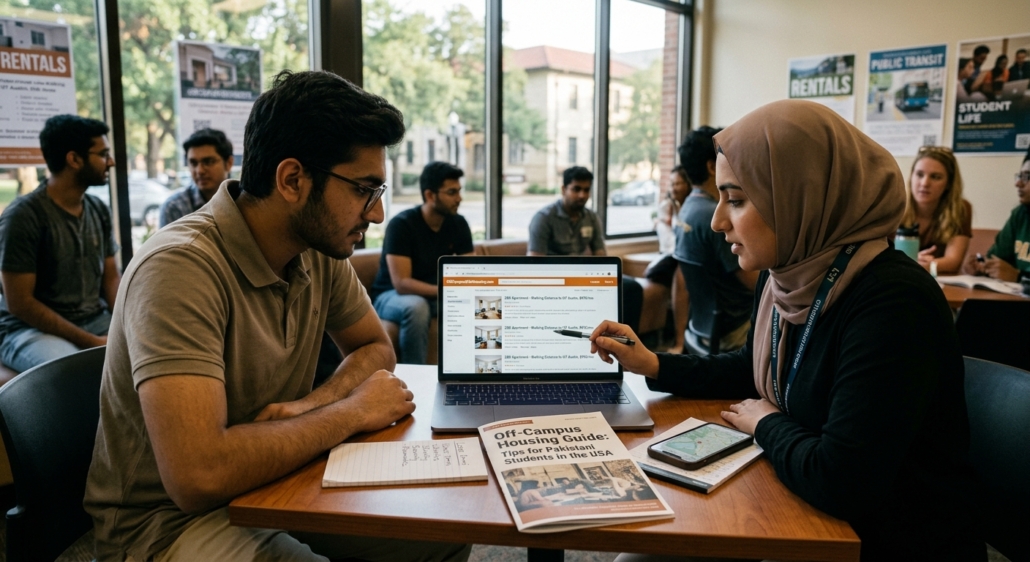
Off-campus housing USA works differently than renting back home
Nobody hands you a checklist for this. Off-campus housing USA runs on a system built around Social Security numbers, US credit scores, and bank accounts you don’t have yet, and most of the advice online is written for American students who already have all three. You don’t, and that changes almost every step.
This isn’t a reason to panic. It’s a reason to plan differently than your roommate from Ohio does.
Is off-campus housing USA actually cheaper than the dorm?
Sometimes. Not always, and the pages that tell you off-campus is automatically cheaper are skipping the parts that make it expensive: furniture, utilities, a security deposit, and often a broker’s fee if you go through an agent in a big city.
|
Factor |
On-campus dorm |
Off-campus rental |
|---|---|---|
|
Upfront cost |
One semester fee, sometimes with a payment plan |
First month + last month + deposit, often 2–3x rent at once |
|
Utilities |
Usually included |
Often separate; electricity, gas, internet billed individually |
|
Furniture |
Provided |
You buy or rent it, unless the listing says furnished |
|
Flexibility |
Fixed academic-year contract |
Leases from 6 to 12 months, with surcharges for shorter terms |
|
Roommate control |
Assigned or randomized |
You choose, or use a roommate finder for international students |
Short-term leases are the trap. A 6- or 10-month lease timed to your academic year usually costs more per month than the standard 12-month version, and University of Florida puts that surcharge at roughly $100 a month above standard rent. If you’re only staying two semesters, do the math on whether subletting a 12-month lease beats paying that premium.
Where to actually look
Skip generic apartment apps for your first search. Places4Students lists over 150,000 units across North America and works directly with more than 245 colleges, according to Places4Students, which means the listings are pre-filtered for student housing near campus rather than mixed in with every rental in the city. Student.com is worth checking too if you’re headed to New York specifically. It carries roughly 150 accommodation listings across neighborhoods like Tribeca, Alphabet City, the Upper East Side, and Brooklyn, per Student.com. Your university’s international student office almost always keeps its own informal list too, usually more current than anything you’ll find by googling.
The no-credit, no-SSN problem, and how landlords actually handle it
Here’s the part every Pakistani student hits in month one: you have no US credit history, because you’ve never had a US bank account, a US phone bill, or a US credit card. Most landlords run a credit check as standard practice, and a blank file reads to them as risk, not as “new arrival.”
Three things actually work around this, and you should try them in this order.
-
A larger security deposit. Many landlords who rent regularly to international students will simply ask for two or three months up front instead of running a credit check at all.
-
A guarantor service. Companies like Insurent or TheGuarantors act as a paid co-signer, charging a percentage of a year’s rent, usually cheaper than losing the apartment entirely.
-
A US-based co-signer. If you have a relative or family friend already settled in the States, their signature on the lease often does more than any deposit.
A blank credit file is not a rejection, it’s just a landlord asking you to prove reliability a different way.
What documents landlords actually ask for
Expect a request for your passport, your I-20 or DS-2019, your admission letter, and proof of funds, usually a bank statement or a scholarship confirmation letter from your university. Some smaller landlords near campus will accept just the I-20 and a deposit and skip the rest entirely, but don’t count on that until you’ve asked directly.
Can you sign a lease from Lahore or Karachi before you land?
Yes, and for buildings that specialize in student housing near campus this is routine, not unusual. Many properties near large universities handle international leases every August and September and have a remote process built for exactly this. What they don’t always tell you upfront is the cancellation clause: if your visa is delayed and you can’t arrive by the start date, some leases still hold you to the full term. Read that clause before you wire a deposit, not after.
Getting money out of Pakistan and into a US landlord’s account
This is the part almost none of the American housing guides cover, because it isn’t their problem. Yours is different. The State Bank of Pakistan places limits on foreign remittance through personal bank accounts, and international card transactions carry their own annual caps depending on your bank and card tier. A deposit plus first month’s rent on off-campus housing USA can easily run to $2,000 or $3,000, and that single transfer may bump against your card’s limit or trigger extra documentation at your bank.
Work this out before you’re mid-lease-signing under pressure. Talk to your bank about remittance limits for education-related transfers specifically, since some banks process these under a different, higher allowance than ordinary personal transfers. A wire transfer through the bank is usually more reliable than a card payment for amounts this size, even though it’s slower, and landlords are generally fine waiting two or three extra business days if you tell them upfront.
Finding housing near halal food, a mosque, or other students who share your comfort level
This is the gap in almost every guide written for international students generally, and it matters a lot more than it sounds. If you want to be within walking distance of a halal grocery or a mosque, that’s not a preference the big listing sites let you filter by, so you’re doing this the manual way.
Search Facebook groups named after your specific university plus “Pakistani” or “Muslim Student Association”, which almost every large campus has. These groups are where students already living there post their room openings before the listing ever goes public, and they’re also where you’ll find out which apartment complexes have a meaningful South Asian or Muslim student population already, which matters if gender-segregated shared housing is something you’re looking for specifically. Ask directly in these groups: “which buildings near campus are close to a halal grocery and have single-gender floors or units.” You’ll usually get three or four names within a day.
Setting up electricity, gas, and internet without an SSN
Utility providers are often stricter about identity documents than landlords are, and this trips up a lot of new arrivals who assumed the hard part was over once the lease was signed. Most electricity and gas companies will let you open an account without an SSN, but they’ll usually ask for a larger security deposit, sometimes $100 to $250, held until you’ve built a payment history with them.
Internet providers tend to be easier, since most will accept a passport and a US address without asking for an SSN at all. If your building advertises itself as all-inclusive, meaning utilities are folded into rent, this entire problem disappears, and it’s one more reason those listings are worth paying slightly more for in your first year.
One more thing worth doing in week one: get renters insurance for students USA-style, through a provider like Lemonade or through your landlord’s required program if one exists. It’s usually $10 to $20 a month and covers a lot more than people expect, including theft and some liability claims if a guest gets hurt in your apartment.
Individual lease or joint lease: this decision matters more than the apartment itself
A joint lease means every name on it is responsible for the whole rent, together. If your roommate stops paying or leaves the country mid-semester, you and whoever else is on the lease owe the difference, not just your share. An individual lease, common in purpose-built student buildings, makes you responsible only for your own room and your portion of shared costs.
If you’re moving in with people you met through a roommate finder for international students rather than close friends, push for an individual lease if the building offers one. It costs a little more per month, usually, but it removes the single biggest way this kind of arrangement goes wrong.
Avoiding scams when you’re signing from another country
The classic scam targeting international students looks almost identical every time: a listing priced noticeably below the market, a landlord who claims to be traveling and unable to show the unit in person, and a request for a deposit by wire transfer or gift card before you’ve seen anything. If a landlord refuses a video call walkthrough, that’s the whole answer right there.
Before sending anything, ask for the exact building address and look it up independently, not through a link they send you. Ask your university’s international office if they’ve heard of the property or the management company. And never send a deposit to a personal account instead of a company or property management account; that single detail catches most of these before they cost you anything.
Frequently asked questions
Can an international student sign a US apartment lease before arriving in the country?
Yes, and for student-heavy buildings near campus it is common. Most properties that specialize in student housing near campus will let you sign digitally and pay the first month plus deposit by card or wire before you land. Read the lease clause on cancellation carefully, because some buildings do not refund if your visa is delayed.
How can an international student rent an apartment in the USA without a US credit score?
Landlords who deal regularly with international students usually accept a larger upfront deposit, often two to three months’ rent, in place of a credit check. A US-based guarantor or a co-signer service such as Insurent or TheGuarantors is the other common route, and both cost a fee on top of your rent.
What documents do US landlords require from international students?
Expect to be asked for your passport, your I-20 or DS-2019, proof of admission, and proof of funds such as a bank statement or scholarship letter. Some landlords will also ask for a letter from your university’s international office confirming your enrollment.
Is it cheaper for international students to live on campus or off campus in the US?
It depends entirely on the city and the building, not on a general rule. Off-campus rentals shared with two or three roommates are often cheaper per person than a dorm, but add utilities, furniture, and transport, and the gap narrows or disappears.
What is the difference between an individual lease and a joint lease for student apartments?
A joint lease makes every roommate legally responsible for the full rent, so if one person stops paying, the rest of you owe it. An individual lease makes you responsible only for your own room and share of rent, which is safer if you are moving in with strangers rather than friends.
{“@context”:”https://schema.org”,”@type”:”FAQPage”,”mainEntity”:[{“@type”:”Question”,”name”:”Can an international student sign a US apartment lease before arriving in the country?”,”acceptedAnswer”:{“@type”:”Answer”,”text”:”Yes, and for student-heavy buildings near campus it is common. Most properties that specialize in student housing near campus will let you sign digitally and pay the first month plus deposit by card or wire before you land. Read the lease clause on cancellation carefully, because some buildings do not refund if your visa is delayed.”}},{“@type”:”Question”,”name”:”How can an international student rent an apartment in the USA without a US credit score?”,”acceptedAnswer”:{“@type”:”Answer”,”text”:”Landlords who deal regularly with international students usually accept a larger upfront deposit, often two to three months’ rent, in place of a credit check. A US-based guarantor or a co-signer service such as Insurent or TheGuarantors is the other common route, and both cost a fee on top of your rent.”}},{“@type”:”Question”,”name”:”What documents do US landlords require from international students?”,”acceptedAnswer”:{“@type”:”Answer”,”text”:”Expect to be asked for your passport, your I-20 or DS-2019, proof of admission, and proof of funds such as a bank statement or scholarship letter. Some landlords will also ask for a letter from your university’s international office confirming your enrollment.”}},{“@type”:”Question”,”name”:”Is it cheaper for international students to live on campus or off campus in the US?”,”acceptedAnswer”:{“@type”:”Answer”,”text”:”It depends entirely on the city and the building, not on a general rule. Off-campus rentals shared with two or three roommates are often cheaper per person than a dorm, but add utilities, furniture, and transport, and the gap narrows or disappears.”}},{“@type”:”Question”,”name”:”What is the difference between an individual lease and a joint lease for student apartments?”,”acceptedAnswer”:{“@type”:”Answer”,”text”:”A joint lease makes every roommate legally responsible for the full rent, so if one person stops paying, the rest of you owe it. An individual lease makes you responsible only for your own room and share of rent, which is safer if you are moving in with strangers rather than friends.”}}]}


Leave a Reply
Want to join the discussion?Feel free to contribute!