
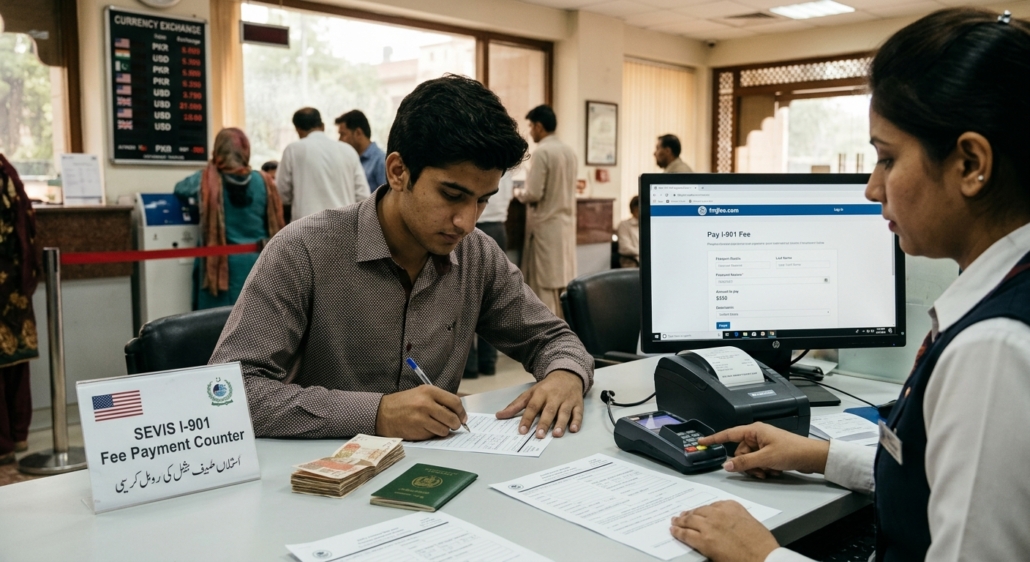
Why the SEVIS fee payment trips up Pakistani students specifically
Most Pakistani students get the SEVIS fee payment wrong in one of two ways: they pay too early, before their I-20 details are finalized, or they hit a bank decline they never saw coming. Neither mistake is fatal, but both cost time you don’t have three weeks before a visa interview.
The form itself, Form I-901, takes about ten minutes to fill in. The part that actually eats a day or two is getting a Pakistani debit or credit card to work on a US-based payment gateway, and almost none of the official guidance mentions that this is where things go sideways.
How much you’re actually paying
The fee amount depends on your visa category, not your university or your country. nnuimmigration.com lists the current figures clearly.
|
Visa type |
SEVIS I-901 fee |
Who pays it |
|---|---|---|
|
F-1 |
$350 |
The student |
|
M-1 |
$350 |
The student |
|
J-1 |
$220 |
The exchange visitor (some government-funded programs exempt) |
|
F-2 / M-2 / J-2 |
$0 |
Exempt dependents |
Dependents holding F-2, M-2, or J-2 status don’t pay this fee at all, a point nnuimmigration.com confirms and one that surprises a lot of families who assume every visa in the household needs its own payment.
The bank problem nobody’s guide actually solves
Here’s the part the American university checklists skip entirely. FMJfee.com is a US e-commerce gateway, and most Pakistani debit cards from UBL, HBL, MCB, or Meezan are not enabled for international online transactions by default. The payment simply gets declined at the last step, with no useful error message.
You fix this by activating international e-commerce on your card first, usually through your bank’s mobile app or a branch visit, sometimes with a same-day turnaround and sometimes not. Do this before you sit down to pay, not after your first attempt fails.
Even once the card works, expect two extra charges you didn’t budget for. Pakistani banks apply a currency conversion markup, typically a few percent above the interbank rate, and the State Bank of Pakistan’s rules mean an advance tax on international card transactions can also get deducted. Neither shows up on the FMJfee.com screen, so the amount that leaves your account will be higher than $350.
No international card? Here’s what still works
This is where most Pakistani students actually succeed, and it isn’t the credit card route.
-
A relative or friend abroad, in the US, UK, or Gulf, pays using their own card, entering your SEVIS ID and I-20 details exactly as printed. FMJfee.com does not require the payer’s name to match the student’s.
-
Some students use a credit card from a family member with international transactions already enabled, rather than trying to activate a fresh debit card under time pressure.
-
A small number go through education consultants or agents who handle the SEVIS fee payment as part of a service package. This works but adds a fee on top, so check what you’re actually being charged before agreeing.
The workaround that actually saves time is asking someone abroad to pay for you, not fighting with your own bank’s international activation process the week before your interview.
Doing the SEVIS fee payment step by step on FMJfee.com
The steps themselves are straightforward once the card issue is out of the way.
-
Go to FMJfee.com and select Form I-901.
-
Enter your SEVIS ID, found in the top-right corner of your I-20 (or DS-2019 for J-1) — it starts with N followed by ten digits.
-
Enter your school or program code, also printed on the I-20, and your personal details exactly as they appear on that document.
-
Choose the payment method: credit or debit card is fastest; a Western Union-style option exists in some regions but is rarely worth the delay for Pakistani applicants.
-
Pay the fee, then immediately download and print the confirmation receipt.
Keep that receipt as a PDF and a hard copy. It’s the one document visa officers ask for that has no digital backup on their end if your printer jams the morning of your interview.
How long before your interview you should actually pay
The stated advice is to pay at least three business days before your interview, a threshold nnuimmigration.com repeats and one worth taking literally, not as a suggestion. In practice, for students paying from Pakistan, a week is the safer number once you account for card activation delays and bank confirmation lag.
This fee is one piece of a sequence that includes your DS-160 form, your interview scheduling, and document prep, and it’s worth sequencing them correctly rather than paying the fee the same night you book your slot. If you’re still working out what to expect at the counter, the F1 visa interview tips for 2026 cover the questions officers actually ask once you’re through the door.
One case worth knowing: if you fell out of F-1 or M-1 status for more than five months, you don’t just resubmit the old receipt. studyinthestates.dhs.gov confirms you must pay a brand new SEVIS fee before applying for reinstatement, even though you already paid once.
SEVIS fee payment and the MRV fee are not the same bill
Students confuse these constantly, and the confusion causes real problems at the bank.
|
SEVIS I-901 fee |
MRV visa fee |
|
|---|---|---|
|
Paid to |
US Department of Homeland Security via FMJfee.com |
US Embassy, via a designated bank in Pakistan |
|
Amount |
$350 (F-1/M-1), $220 (J-1) |
Set separately, non-refundable, category-based |
|
When |
Before scheduling your interview |
Before or when scheduling your interview |
|
Refundable if visa denied |
No |
No |
The SEVIS fee is non-refundable even if your visa gets denied at the interview, a point confirmed by placement-international.com. That’s true whether the denial was a paperwork issue or something in the interview itself, so there’s no version of this where the $350 comes back to you.
Who’s exempt, and who gets caught out anyway
F-2, M-2, and J-2 dependents are exempt from the SEVIS fee payment entirely, and so are most participants in federally funded J-1 exchange programs. Where students get caught out is assuming a scholarship or university-funded program counts as an exemption. It usually doesn’t. The exemption is about who is funding the specific J-1 program at a federal level, not whether you personally received financial aid.
If your I-20 changes, say your school code updates after a transfer, you don’t automatically need to pay again. But if your SEVIS record was terminated and reactivated, treat that as a fresh case and check with your school’s international office before assuming your old receipt still counts.
Frequently asked questions
How much is the SEVIS I-901 fee for F-1 students?
F-1 and M-1 students pay $350. J-1 exchange visitors pay $220 in most cases, though certain government-sponsored J-1 programs are exempt. The amount is fixed by visa category, not by university or program length.
Can someone else pay the SEVIS fee on my behalf?
Yes, and this is genuinely common for Pakistani students. A relative or friend abroad can pay using their own card as long as your SEVIS ID and I-20 details are entered correctly, since FMJfee.com doesn’t require the payer’s name to match the student’s.
How long before my visa interview should I pay the SEVIS fee?
At least three business days, though a full week gives you room for Pakistani bank delays around international card activation. Print the receipt as soon as payment clears rather than the night before your interview.
Is the SEVIS fee refundable if my visa is rejected?
No. The fee is non-refundable even if the visa application is denied at the interview stage, regardless of the reason for the denial.
What is the difference between the SEVIS fee and the MRV visa application fee?
The SEVIS fee is paid once to the Department of Homeland Security through FMJfee.com and funds the tracking system for international students. The MRV fee is a separate charge paid to the US Embassy or a designated bank in Pakistan as part of the visa application itself.
{“@context”:”https://schema.org”,”@type”:”FAQPage”,”mainEntity”:[{“@type”:”Question”,”name”:”How much is the SEVIS I-901 fee for F-1 students?”,”acceptedAnswer”:{“@type”:”Answer”,”text”:”F-1 and M-1 students pay $350. J-1 exchange visitors pay $220 in most cases, though certain government-sponsored J-1 programs are exempt. The amount is fixed by visa category, not by university or program length.”}},{“@type”:”Question”,”name”:”Can someone else pay the SEVIS fee on my behalf?”,”acceptedAnswer”:{“@type”:”Answer”,”text”:”Yes, and this is genuinely common for Pakistani students. A relative or friend abroad can pay using their own card as long as your SEVIS ID and I-20 details are entered correctly, since FMJfee.com doesn’t require the payer’s name to match the student’s.”}},{“@type”:”Question”,”name”:”How long before my visa interview should I pay the SEVIS fee?”,”acceptedAnswer”:{“@type”:”Answer”,”text”:”At least three business days, though a full week gives you room for Pakistani bank delays around international card activation. Print the receipt as soon as payment clears rather than the night before your interview.”}},{“@type”:”Question”,”name”:”Is the SEVIS fee refundable if my visa is rejected?”,”acceptedAnswer”:{“@type”:”Answer”,”text”:”No. The fee is non-refundable even if the visa application is denied at the interview stage, regardless of the reason for the denial.”}},{“@type”:”Question”,”name”:”What is the difference between the SEVIS fee and the MRV visa application fee?”,”acceptedAnswer”:{“@type”:”Answer”,”text”:”The SEVIS fee is paid once to the Department of Homeland Security through FMJfee.com and funds the tracking system for international students. The MRV fee is a separate charge paid to the US Embassy or a designated bank in Pakistan as part of the visa application itself.”}}]}


Leave a Reply
Want to join the discussion?Feel free to contribute!