
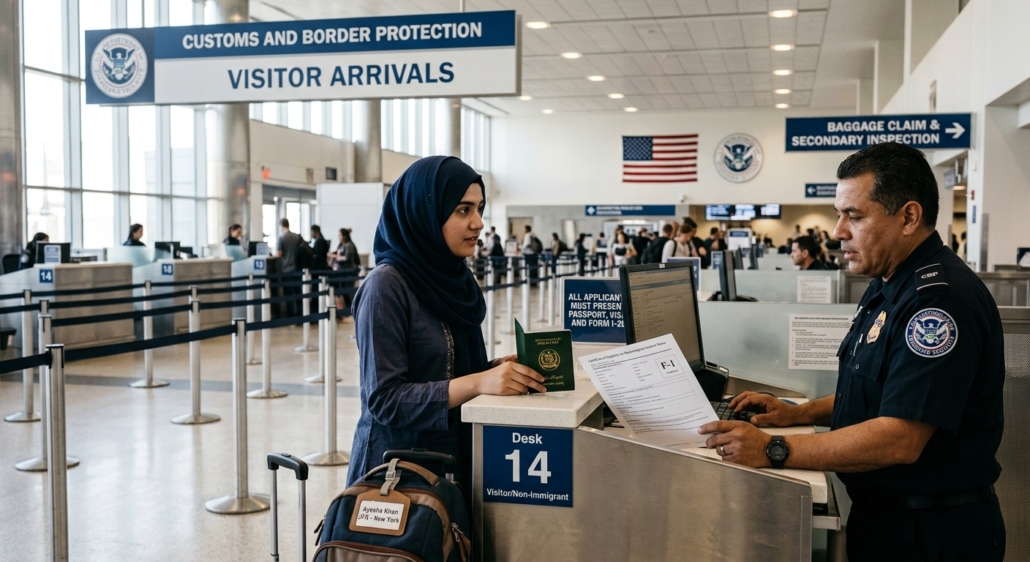
The airport isn’t the hard part. This is.
Most Pakistani students spend months on the DS-160 form and the visa interview, then treat the actual arrival as an afterthought. That’s backwards. The visa gets you on the plane. The officer standing at the US port of entry is the one who decides whether you actually get into the country, and that decision outranks the visa stamp already in your passport.
US Customs and Border Protection runs 328 ports of entry across the country, covering airports, land crossings, and seaports. For almost every F-1 student flying from Lahore, Karachi, or Islamabad, that first American checkpoint is an airport, and the process there is the same whether you land in New York, Chicago, or Houston.
What actually happens between the plane door and the exit
You walk off the plane and follow signs for “Immigration” or “Passport Control.” If you are not a US citizen or permanent resident, you join the non-US passport line. This is primary inspection, and it is usually quick: a CBP officer scans your passport, checks your visa, and asks you one or two direct questions. Most students clear this in under five minutes.
If the officer is satisfied, you get an electronic I-94 arrival record created automatically in the system (you can retrieve a copy later at cbp.gov, and you should, because landlords, banks, and your university’s international office will ask for it). Then you collect your checked luggage, walk it through a customs checkpoint, and either exit the airport or re-check it for a domestic connecting flight. There is no shortcut around that bag claim and re-check step, even if your real destination is three states away.
Can you land somewhere other than your university city?
Yes, and plenty of students do it without even realizing it is a choice. There is nothing in F-1 rules that ties your port of entry to the city your school is in. A student headed to a university in Ohio might fly into Dulles or JFK, clear customs and immigration there, re-check luggage, and take a short domestic hop to finish the trip. The only thing that matters is that the documents presented at that first checkpoint are correct, not which city it happens to be.
The documents that actually get checked at the US port of entry
Officers see thousands of students a week and they know exactly what they’re looking for. Having filled out your DS-160 form correctly matters here too, because the information on it should still line up with what’s on your paperwork at arrival. Keep these in your carry-on, not your checked bag:
-
A passport valid for at least six months from your date of entry, a requirement several university international offices, including Washington University’s OISS, flag as a common reason students get pulled aside.
-
Your original, signed Form I-20, with the school official’s signature and your own signature on page one.
-
Your F-1 visa stamp, obviously, but also the visa approval letter and SEVIS fee receipt if you still have them.
-
Proof of funding: a bank statement, scholarship letter, or sponsor affidavit matching what you declared during your visa interview.
-
Your university admission letter and, if you have one, contact details for your school’s international student office.
A folder with physical copies beats a phone full of screenshots, because officers can ask you to hand over paper and a dead battery should never be the reason you get stuck.
The 30-day rule, and why people get it wrong
New F and M students can enter the United States up to 30 days before the program start date on their Form I-20, according to Study in the States, the Department of Homeland Security’s own student visa site. The mistake students make isn’t arriving too early on paper; it’s arriving within the window but with nowhere confirmed to stay and no clear answer when asked why they’re three weeks ahead of orientation. If you’re arriving early to deal with a US bank account or housing, say so. Vague answers read as suspicious even when the timing itself is fine.
Secondary inspection: what it actually looks like
Getting sent to secondary isn’t rare and it isn’t a verdict. It happens for reasons as mundane as a name that matches another record, a SEVIS entry that hasn’t synced yet, or an officer who just wants to confirm your enrollment with the school directly. You wait in a separate room, sometimes for twenty minutes, sometimes longer, and a different officer goes through your file in more detail.
|
Primary inspection |
Secondary inspection |
|---|---|
|
Same officer, same booth, a few questions |
Different officer, separate room |
|
Usually 2 to 5 minutes |
20 minutes to a few hours |
|
Checks passport, visa, I-20 at a glance |
May call your school, verify funding, inspect devices |
|
Ends with I-94 issued |
Ends with I-94 issued, or further review |
CBP has authority at a US port of entry to search electronic devices, including phones and laptops, without a warrant. This surprises a lot of students, and no, having a password doesn’t exempt you. If asked, officers typically want to confirm your identity and your ties to school and family, not read your messages for fun. Keep the device unlocked and cooperative, and keep the conversation factual.
Spices, sweets, and the medicine you shouldn’t forget to declare
This is the part most guides skip entirely, and it’s the part that actually trips Pakistani students up. Sealed, commercially packaged spices are generally fine. Homemade achaar, loose masalas packed in a dabba, dried meat, or fresh fruit are the things customs most often pulls aside, and declaring them upfront is always safer than hoping they go unnoticed. Mithai in sealed boxes usually clears without issue; unpackaged sweets from a local shop are a judgment call that can go either way.
Prescription medication needs to stay in its original packaging with your name on it, ideally with a doctor’s note if it’s something like a controlled stimulant for ADHD. Carrying loose pills in a plastic pouch, even if it’s just paracetamol, is the kind of thing that turns a five-minute customs stop into a thirty-minute one.
Once you’re through
Clearing the US port of entry is the start of a list of small, boring tasks, not the end of one. You’ll need that I-94 record for almost everything that follows, starting with opening a US bank account, which most students handle in the first week because landlords and phone carriers both expect a US account number fast. Don’t treat the airport as the finish line. It’s the first checkpoint in a semester full of them.
FAQ: landing as an F-1 student
What questions do CBP officers ask F-1 students at the airport?
Expect questions about your university, your major, how you are funding your education, and where you plan to live. Officers often ask what your SEVIS school name is, who paid your tuition deposit, and whether you intend to work in the US. Answer plainly and match what is written on your I-20; contradictions are what trigger follow-up questions, not the questions themselves.
Can an F-1 student enter the US through a different city than where their university is located?
Yes. You can land at any US port of entry that has a CBP inspection station, regardless of where your school is. Many students fly into a hub like New York or Chicago and connect domestically to a smaller college town, and this has no effect on your F-1 status as long as your documents are in order.
How many days before the I-20 start date can an international student arrive in the US?
New F and M students can arrive up to 30 days before the program start date listed on their Form I-20, according to Study in the States, the Department of Homeland Security’s own guidance site. Arriving earlier than that window is the single most common reason F-1 students get flagged for extra questioning.
What happens if an international student is sent to secondary inspection?
You are taken to a separate room where a different officer reviews your documents more closely, may call your school’s international office to confirm your enrollment, and can ask to look through your phone or laptop. It is not an accusation. It usually means something on your paperwork needed a second look, and it can add anywhere from twenty minutes to a few hours to your arrival.
Do international travelers have to collect and re-check bags at their first US port of entry?
Yes, almost always. Your first US landing is where you clear customs, which means collecting your checked bags, carrying them through the customs exit, and re-checking them for your connecting domestic flight if you have one. This applies even if your final destination is a different city.
{“@context”:”https://schema.org”,”@type”:”FAQPage”,”mainEntity”:[{“@type”:”Question”,”name”:”What questions do CBP officers ask F-1 students at the airport?”,”acceptedAnswer”:{“@type”:”Answer”,”text”:”Expect questions about your university, your major, how you are funding your education, and where you plan to live. Officers often ask what your SEVIS school name is, who paid your tuition deposit, and whether you intend to work in the US. Answer plainly and match what is written on your I-20; contradictions are what trigger follow-up questions, not the questions themselves.”}},{“@type”:”Question”,”name”:”Can an F-1 student enter the US through a different city than where their university is located?”,”acceptedAnswer”:{“@type”:”Answer”,”text”:”Yes. You can land at any US port of entry that has a CBP inspection station, regardless of where your school is. Many students fly into a hub like New York or Chicago and connect domestically to a smaller college town, and this has no effect on your F-1 status as long as your documents are in order.”}},{“@type”:”Question”,”name”:”How many days before the I-20 start date can an international student arrive in the US?”,”acceptedAnswer”:{“@type”:”Answer”,”text”:”New F and M students can arrive up to 30 days before the program start date listed on their Form I-20, according to Study in the States, the Department of Homeland Security’s own guidance site. Arriving earlier than that window is the single most common reason F-1 students get flagged for extra questioning.”}},{“@type”:”Question”,”name”:”What happens if an international student is sent to secondary inspection?”,”acceptedAnswer”:{“@type”:”Answer”,”text”:”You are taken to a separate room where a different officer reviews your documents more closely, may call your school’s international office to confirm your enrollment, and can ask to look through your phone or laptop. It is not an accusation. It usually means something on your paperwork needed a second look, and it can add anywhere from twenty minutes to a few hours to your arrival.”}},{“@type”:”Question”,”name”:”Do international travelers have to collect and re-check bags at their first US port of entry?”,”acceptedAnswer”:{“@type”:”Answer”,”text”:”Yes, almost always. Your first US landing is where you clear customs, which means collecting your checked bags, carrying them through the customs exit, and re-checking them for your connecting domestic flight if you have one. This applies even if your final destination is a different city.”}}]}

Leave a Reply
Want to join the discussion?Feel free to contribute!